Posts

Truth and lies - How they affect your health

Introduction Each day, we have to make the same choice umpteen times: whether to lie or tell the truth. And most often we lie oblivious of the fact that even the smallest lies can affect us in a harmful manner. That’s why the ancient Indian scriptures preach- “Nanruta bruyat” [One should not tell a lie.] What is a lie? A lie is a false statement deliberately presented as being true. In simple words as per Ayurveda, anything said that is opposite of Truth is a lie. But how many of us choose not to lie at all? A study conducted on this subject makes an interesting observation on the frequency of lies in our daily conversations. In a 2002 study by Robert Feldman of the University of Massachusetts, it was found that on an average, people told two to three lies in a ten-minute conversation. Needless to say, the report reflects more or less a global trend. Why do people lie? People lie because they are fearful of the consequences of telling the truth. Mostly they are a...
The glory of Nama Japa or repetition of Divine Name

Often we come across devotees who take their Ishta Deva's or desired deity’s name either loudly or silently throughout their daily routine. For those who are not familiar with this act may ask what is the significance of this act of repetition of the Lord’s name? Or how this act will benefit the devotees in their spiritual path? The answer to the above questions would be – This continous chanting or repetition of Lord’s name while carrying out our daily routine is called “ Nama Japa ”. It calms and strengthens the mind; eradicates all kinds of evil thoughts; makes the mind introspective and forces the mind to move towards God and eventually helps to have a Darshan or glimpse of one’s Ishta Deva or God realisation. By taking Lord Rama’s name that too reversely, Ratnakara, a rogue became Valmiki – a great sage who authored Ramayana. Tukaram, a great saint had direct darshan or glimpse of Lord Krishna by repeating simply “Vitthal, Vitthal” (another name for Lord Krishna). Su...

Relevance of Truth in the age of Instant Noodles

The current age ( Kali Yuga ) can be called as the age of “Instant Noodles”, where Noodles is a metaphor for things people want instantly in their life like money, name, fame etc. But they know that, though they can cook the Noodles instantly, to get the “Real Noodles” (money, name, fame etc.)  in a short time, that too in a fair way and by following the path of Truth, is a difficult task. Because, this path may not give them instant results. So they tread the path of falsehood for getting them in the shortest possible time and invite troubles through bad karma. But little do they know, that with little patience, they can get whatever they desire by the power of Truth alone. That’s why the Upanishad says- " Satyameva Jayate " (सत्यमेव जयते) This verse from the “ Mundaka Upanishad ” is the National Motto of India. It tells us that – Truth alone triumphs; Not falsehood ( satyameva jayate nānṛtaṁ ). The Shiva Purana also emphasizes upon the path of Truth and tells that on...

Oneness of Lord Shiva and Lord Vishnu

Image
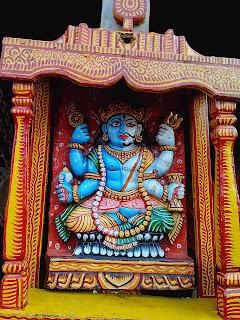
Since the origin of the Vaishnava and Shaiva cult, there have been differences between these two regarding the supremacy of one over the other. It was even instructed to followers of both the sects that – Even if they are chased by a tiger, they should not take shelter in the temple of the opposite sect. But the scriptures say that Shiva and Vishnu cannot be differentiated; as in essence they are the same. Let’s see what the scriptures tell about the oneness of these two Gods. Shiva Purana states – 1. Vishnu resides in my (Shiva’s) heart and I (Shiva) reside in Vishnu’s heart. He, who does not differentiate us (Shiva and Vishnu), is especially liked by me (Shiva). 2. He, who takes refuge in You (Vishnu), definitely takes refuge in me (Shiva) also. He, who differentiates us (Shiva & Vishnu), goes to hell for sure. 3. He, who disapproves of You (Shiva) being my (Vishnu’s) devotee, should surely be sent to hell by You (Shiva). He, who is Your (Shiva’s) devotee, is extre...

Why Cow is considered sacred and worshipped by the Hindus

The Hindus consider the cow as sacred and worship her as their mother. But few people know about the reason behind it.  Let us read what the ancient Holy Scriptures say about the greatness of the cow – The Vedas say –   Cows are the mother of the universe. They are the mother of the rudras , the daughter of the vasus and the sister of the adityas . They are the nucleus of nectar (milk). So never ever kill the cows which are innocent and not to be killed. As per puranas , all important deities and heavenly beings reside in the body of the cow such as Brahma , Vishnu , Shiva , Saraswati , Lakshmi , Gouri , Vasus , Rudras , Gandharvas , Pitrus etc. In the hair follicles of the cow reside thirty three (33) types of  devas . The Dharma with its four feet, the four vedas , the agnis and the yajna , all reside in the body of the cow. All the lokas (worlds) are established in the cow. So the Cows are sacred and auspicious. In ancient times cows had an important rol...

Avatars of Lord Shiva

In the Shatarudra Samhita of Shiva Purana, various Shiva avatars are described. Lord Shiva has taken innumerable avatars. Only a few of them have been mentioned. In the 19th Kalpa, called as "Shwetalohita" Kalpa, Shiva took the "Sadyojata" avatar. When Lord Brahma was meditating to get a son, a child was born whose body was shwetalohita or white & red. Then Brahma realized that he was none other than Shiva Himself and worshiped Him. Then in the 20th Kalpa called as "Rakta", Brahma was meditating to get a son. Then a son was born from him whose body was adorned with red garments and red garland. His eyes were red and also his ornaments. He was called as "Vamadeva".Then in the 21st Kalpa called as "Pitavasa", Brahma was again meditating to get a son. At that time a son was born from him who had worn yellow garments and had huge & powerful arms. Then Brahma came to know that he was Shiva in form of "Tatpurusha". Then i...

Many kinds of ‘Gita’s – a bird’s eye view

‘Gita’ is commonly understood as the ‘Bhagavad Gita’ in which Lord Krishna preaches Arjuna on various aspects of life. But you will be surprised to know that there are about sixty different kinds of ‘Gita’ which exist in the rich Indian tradition and each has got its own special place in the cultural heritage and the devotee's heart. Gita is song or verse that appeals directly to the human heart. Verse is fluent to recite and easy to memorize. The ‘Gita’s contain instructions or answers given by the learned ones (Jivanmuktas and Aparoksha-Jnanis) to the eager questionings of earnest seekers. So let us know about them. 1. Guru Gita – Conversation between Lord Shiva and Goddess Parvati. It stresses the need for and the importance of seeking a Spiritual Teacher (Guru) and extols his greatness. It is described in Skanda Purana. 2. Ashtavakra Gita – Conversation between Sage Ashtavakra and King Janaka. It speaks about Advaita Vedanta, bondage and self-realization. It emphasizes ...