Posts

Ishta Deva of Lord Jagannath

Image
Lord Jagannath or the Lord of the Universe is regarded as the supreme deity amongst the Hindus. But the beauty lies in the fact that even Lord Jagannath has his Ishta Deva - Lord Ishaneshwar (Lord Shiva). In Shivashtakam it is written that - प्रभुं प्राणनाथं विभुं विश्वनाथं जगन्नाथ नाथं सदानन्द भाजाम् । भवद्भव्य भूतॆश्वरं भूतनाथं, शिवं शङ्करं शम्भु मीशानमीडॆ I pray to You, Shiva, Shankara, Shambhu, Who is the Lord, Who is the Lord of our lives, Who is Vibhu, Who is the Lord of the world, Who is the Lord of Jagannatha (Vishnu), Who is always dwelling in happiness, Who imparts light or shine to everything, Who is the Lord of living beings, Who is the Lord of ghosts, and Who is the Lord of everyone. It is futile to debate who is superior to whom, as the trinities in Hinduism - Lords Brahma, Vishnu and Maheshwar (Shiva) are basically inseparable and appear as different depending upon their attributes and roles in this cosmic play. Once Lord Shiva was asked at the time of His marr...
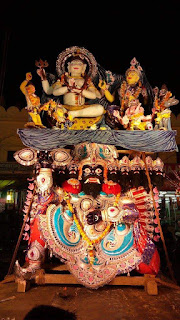
Why Ravana should not be glorified

Image
Now a days it has become a trend to glorify certain traits of Ravana like he never violated the modesty of Sita though he abducted her and he was a great devotee of Lord Shiva. And this discussion comes up especially during the time of Dussehra when Ravana's efigy is burnt. Many people oppose this tradition by giving examples about the positive traits of Ravana as described earlier. Now I am not raising an argument about whether Ravana's efigy should be burnt or not, rather I would like to clear the misconceptions about the positive traits of Ravana which he never had. Myth #1: Ravana never violated the modesty of Sita. Fact: It is true that Ravana never violated the modesty of Sita, but it was not due to his greatness, rather it was due to a curse inflicted upon him for which he didn't dare to do so. Once Ravana came across Rambha, the celestial damsel. Charmed by her beauty, he got hold of her and expressed his desire to make love to her. But Rambha resisted ...

Rathe tu Vaamanam drustva

We have heard a very popular sloka that is as follows – Rathe tu Vaamanam drustva Punarjanmam na vidyate || It means if we see Vaamana or Lord Jagannath on the Chariot during the Rath Yatra or the Car festival, we will never have to take rebirth again. In other words, we will get salvation or moksha or liberation from the cycle of birth and death. But a question comes to our mind that why Lord Jagannath is described here as ‘ Vaamana ’? To know the answer we have to refer to the following sloka – मधुसूदनो वैशाखे ज्येष्ठे त्रविक्रमः पतिः। आषाढे वामानाधीशः श्रावणे श्रीधरः स्मृतः॥ भाद्रवे हृषिकेशश्च पद्मनाभोऽश्विनाधिपः। दामोदरश्च कार्त्तिके मार्गशीर्षे च केशवः॥ पौषे नारायणस्वामी माघाधिपश्च माधवः। फाल्गुने गोविन्दो ज्ञेयो विष्णुश्चैत्रेश्वरोऽपिच॥ It means the combination of Hindu months and their presiding deities are as follows - वेशाख - मधुसूदन , ज्येष्ठ - त्रिविक्रम , आषाढ़ - वामन , श्रावण - श्रीधर , भाद्रव - हृषीकेश , आश्विन - पद्मन...

How to attain Moksha or Liberation

As per Sanatana Dharma or Hinduism, there are four proper goals or aims which are to be achieved in human life. They are - Dharma (Righteousness), Artha (Wealth), Kama (Rightful Desire) and Moksha (Salvation or Liberation). Moksha is the ultimate goal of the human life which liberates a soul from the endless cycle of birth and death. How can one attain Moksha ? The ancient holy texts describe about various ways to attain  Moksha  or liberation from the cycle of birth and death. There are descriptions of holy cities which bestow  Moksha  upon the visitors . Like - Ayodhya Mathura Maya Kasi Kanchi Avantika | Puri Dvaravati chaiva saptaita moksadayikah || ~ Garuda Purana It means that the Sapta Puri or the seven holy cities [Ayodhya, Mathura, Maya (Haridwar), Kasi, Kanchi, Avantika (Ujjain), and Dwarika Puri] bestow  Moksha  upon people who visit them. Again… Dole tu Dolagovindam Chape tu Madhusudanam Rathe tu Vamanam drustva Punarjanma...

How did Hanuman get his name?

Image
Lord Hanuman is an important God as far as Hinduism is concerned. He is one of the Chiranjeevis or the immortals. Apart from his most popular name Hanuman, he is also known as Anjaneya (Son of Anjana), Maruti (Son of Marut, the Wind God), Bajrang Bali (the strong one who has limbs as hard as the Vajra) etc. We may wonder why he was named as Hanuman. There are two stories regarding this. The first story is from Bhavishya Purana. It says – When Hanuman was a child, he mistook the Sun as a fruit and flew towards it to devour it. When he devoured the Sun, darkness prevailed everywhere and all were worried. Seeing this, Ravana, the demon king tried to free the Sun by taking hold of the tail of Hanuman and hung in there. But still Hanuman did not release the Sun from his mouth. After that a fierce fist fighting took place in between Hanuman and Ravana for a whole year. At the end Ravana got tired and tried to escape. But Hanuman did not let him go. At this moment Rishi Vishrav...

From Bhishak to Doctor – Evolution of a Physician’s Title

Times change. Businesses and professions get outdated. But one profession that will never be out of service is the practice of medicine. We will always need the advice of a Physician or a Doctor during an illness. Because, a Physician is an expert in medicine who earns the title of a “Doctor” after years of medical study and internship. Then only can he add the title of “Doctor” before his name and treat patients. But since when this title of Doctor came into existence? Let us have a look. The most ancient books that exist today are believed to be the Vedas whose date of origin is 1500 – c. 500 BCE (it might be even much older than that). All the subjects of science and arts have their original source in the Vedas including the science of medicine. Vedic Gods like Rudra, Agni, Varuna, Indra, Maruta and various other Gods were designated as Divine Physicians. Rudra was described as the "first Divine Physician" and also the “best Physician of Physicians”. The most famous ...

Truth and lies - How they affect your health

Introduction Each day, we have to make the same choice umpteen times: whether to lie or tell the truth. And most often we lie oblivious of the fact that even the smallest lies can affect us in a harmful manner. That’s why the ancient Indian scriptures preach- “Nanruta bruyat” [One should not tell a lie.] What is a lie? A lie is a false statement deliberately presented as being true. In simple words as per Ayurveda, anything said that is opposite of Truth is a lie. But how many of us choose not to lie at all? A study conducted on this subject makes an interesting observation on the frequency of lies in our daily conversations. In a 2002 study by Robert Feldman of the University of Massachusetts, it was found that on an average, people told two to three lies in a ten-minute conversation. Needless to say, the report reflects more or less a global trend. Why do people lie? People lie because they are fearful of the consequences of telling the truth. Mostly they are a...